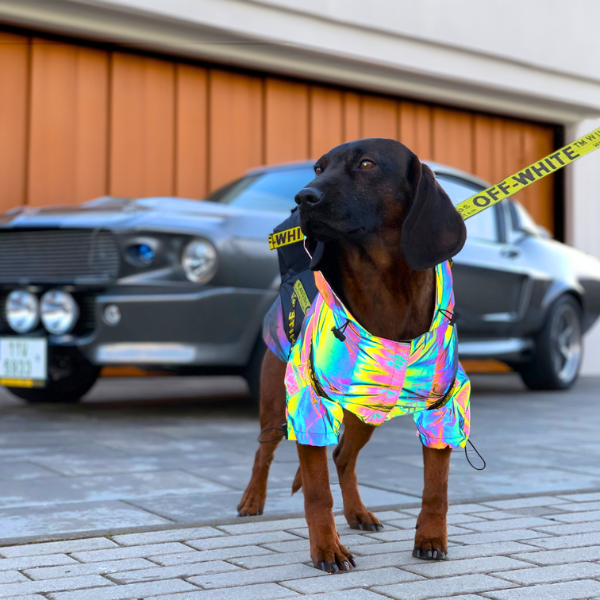
How Should Dog Clothes Fit? Signs a Jacket or Hoodie Is Too Tight
Dog clothes should fit snugly against the body with no tension. The practical test: with the garment on, you should be able to slide two fingers flat between the fabric and your dog’s body at both the neck opening and the widest part of the chest. Your dog should walk, trot, sit, lie down and turn their head without the garment pulling, riding up or bunching. Nothing should gape at the neck or chest, no seam should press into skin, and the back hem should stop just short of the base of the tail.
If you can’t fit two fingers in, it is too tight. If you can fit a whole hand in, or the garment rotates around the body when your dog moves, it is too loose.
Key takeaways
- Two fingers flat, at neck and chest. Less than that is too tight; a loose fist’s worth is too big.
- Fit is judged in motion, not standing still. Most bad fits only reveal themselves at a trot or when the dog sits.
- Check the dog after you take the garment off. Skin indentations, red marks or flattened, broken fur at the armpit and neck are the clearest evidence of excess pressure.
- Measure, don’t guess from weight. Chest girth, neck circumference and back length decide the size. Two 15 lb Chihuahuas can need different sizes.
- Between sizes? Size up in woven or insulated garments, hold your size in four-way stretch knits.
- Freezing, hunching and a tucked tail are fit feedback. A dog that goes statue-still is telling you something, though it is not always pain.
The 30-second fit check
Run this now, with the garment on, in this order. Each step takes about four seconds.
- Neck. Slide two fingers flat under the neck opening. They should go in without forcing and without swimming around. Two fingers is the standard; on a toy breed under 10 lb, one finger with easy movement is the equivalent.
- Chest. Do the same at the widest point of the chest, just behind the front legs. This is the single most important measurement on any dog garment, and it is where tight fits do the most harm.
- Shoulders and withers. Put a hand flat over the withers, the ridge between the shoulder blades. The fabric should lie flat with no tension lines fanning out from the seams.
- Leg holes and armpits. Hook one finger into each leg opening alongside the limb. If the fabric is already pressing on the skin in the axilla (the armpit hollow), the garment is too small or cut too narrow. Look for bulging skin at the rim of the opening.
- Back length. The hem should end roughly 1-2 inches (2.5-5 cm) before the base of the tail. Longer than that gets in the way when the dog relieves itself; much shorter leaves the loin exposed.
- Belly coverage. Check the underside. On a male dog, fabric should sit clear of the prepuce. On a small dog, a belly panel that reaches too far down usually means the garment is too large, not that the dog needs a longer one.
- Movement test. Walk your dog 10-15 paces, then ask for a trot. Watch the front legs from the side. The stride should reach as far forward as it does bare. A shortened stride, a bunny-hopping gait or a dog that paddles the front feet means the shoulders are restricted.
- Sit and lie down. Ask for a sit, then a down. Both should happen in one smooth movement. A dog that half-sits, props itself, or lowers itself in stages is working around the garment.
Fail any one of steps 1, 2, 4 or 7 and treat the garment as too tight. Fail steps 5 or 6 and you are probably one size too big.
Signs a dog jacket or hoodie is too tight
A too-tight garment shows itself in three places: on the fabric, on the dog’s movement and behavior, and on the skin after you take it off. Most owners only look at the first.
What you see on the garment
- Seams under strain, with visible tension lines radiating from the leg openings or the chest panel.
- Stitching that has visibly stretched, so you can see the thread through gaps between fabric.
- Puckering around the zipper or hook-and-loop closure, or a closure you have to pull to meet.
- A neck rib that has lost its shape and stands out as a tight band rather than a soft collar.
- Fabric riding up over the shoulders within a minute or two of being put on, so the chest panel migrates toward the throat.
- Any garment you have to force over the head. If it takes real effort to get on, it is too small, regardless of what the label says.
What you see on the dog
- Skin bulging or pinching at the leg holes. Roll of skin above the rim is the same warning sign used for over-tight collars and harnesses.
- Restricted shoulder extension and a shortened stride. The front limb cannot reach forward through its normal range of motion.
- Difficulty sitting or lying down normally, or sitting with the hind legs splayed to one side.
- Increased or labored breathing, or panting with no change in temperature or activity.
- Coughing or gagging when the neck opening is too narrow. Stop using the garment immediately if this happens.
- Scratching, pawing, chewing or rubbing at the garment, or dragging the body along the floor to shed it.
- Chafing in the axilla. The armpit is the highest-friction point on any dog garment and the first place to go sore.
What you see after you take it off
This is the check almost nobody runs, and it is the most reliable one. Remove the garment and look at the skin and coat underneath, parting the fur with your fingers.
- Indentations or red marks following the line of a seam, neck rib or leg opening. Faint pressure lines that fade within a few minutes are normal. Marks still visible after 15-20 minutes mean the garment is pressing hard enough to restrict blood flow locally, and repeated pressure in the same spot is how a pressure sore starts.
- Flattened, matted or greasy-looking fur in a band that matches a seam.
- Broken hairs or thinning fur at friction points: the armpit, the point of the shoulder, the front of the chest. Repeated rubbing in one spot can cause friction alopecia, localized hair loss from mechanical wear rather than disease.
- Dandruff, scurf or pink skin along contact lines, which can tip into contact dermatitis, an inflammatory skin reaction to something touching the skin. VCA Animal Hospitals lists contact dermatitis among the most common causes of pruritus (itching) in dogs, and notes that persistent self-trauma can lead to hair loss, scabs and raw skin.
- Heat and damp trapped under the garment, particularly in a thick double coat. If the skin feels hot and clammy, the garment is too warm for the conditions as well as possibly too tight.
If your dog already has sensitive skin, the margin for error is smaller. Our guide to small dog skin irritation covers how to spot early reactions and reduce friction.
Signs dog clothes are too loose
Too big is less likely to hurt and more likely to be dangerous. A loose garment is a snag hazard and it does not keep a dog warm.
- The garment rotates or twists around the body. If you can turn it a hand’s width without resistance, it is too big.
- It slips sideways or slides back over the shoulders, so the neck opening ends up around the chest.
- A leg slips out of its leg hole, usually the one on the side the dog turns toward.
- Your dog trips, stumbles or catches a paw in the hem or an opening.
- Fabric bunches under the chest and gathers in the armpits, which creates a bulk-and-friction point even though the garment is oversized.
- The hood falls over the eyes, blocking vision.
- Loose straps, long drawstrings or flapping panels that can catch on furniture, railings, branches or another dog’s teeth during play.
- It does not keep the dog warm. Insulation works by trapping a thin layer of still air against the body. A garment with a gaping air gap loses that warmth to convection, so an oversized winter coat performs worse than a correctly sized lighter one.
- The back hem extends past the base of the tail and gets in the way when the dog relieves itself.
The American Kennel Club makes the same point about baggy sweaters: a dog can get caught or tangled in one, which is uncomfortable, frightening and a trip risk.
Fit reference table
Body area | Correct fit feels like | Too tight | Too loose |
Neck opening | Two fingers slide in flat; the rib sits softly against the coat | Fewer than two fingers; coughing, gagging, a visible band in the fur | A whole hand fits; the opening drops toward the chest |
Chest / girth | Snug contact all round, two fingers flat at the widest point | No finger room; seams strained; breathing effort increases | Garment rotates; air gap you can see daylight through |
Shoulders / withers | Fabric lies flat, no tension lines, full forward reach | Shortened stride, paddling gait, fabric pulls at each step | Garment slides backward off the withers |
Leg holes / axilla | One finger fits beside the limb; no skin contact in the armpit hollow | Skin bulges at the rim; chafing, broken hairs, soreness | Limb slips out; fabric bunches in the armpit |
Back length / topline | Hem stops 1-2 in (2.5-5 cm) before the tail base | Hem rides up over the loin; roached posture | Hem covers the tail base and gets in the way at bathroom breaks |
Belly | Panel clear of the prepuce; no gathering | Panel digs in behind the ribs when the dog sits | Panel hangs and swings; soils easily |
Rear / hem | Stays put through a sit and a down | Pulls forward when the dog sits | Flips up over the back at a trot |
Hood | Sits back off the face; vision unobstructed | Pulls the neck opening tight when up | Falls over the eyes |


Behavioral signals: read the dog, not the label
Your dog’s body language is better fit feedback than any size chart, because it reports on the actual garment on the actual body. PetMD describes the cluster of appeasement and displacement behaviors, what trainers call calming signals, that dogs show when they are stressed or uncomfortable: freezing, looking away, turning away, moving in a curve, slow movements, yawning, lip licking and smacking, raising one paw, scratching and shaking off. The same page notes that a distressed dog may perform exaggerated yawns, sneeze, or lick the lips frequently. A fearful dog adds pinned ears, a tucked tail, a stiff low posture, and whale eye, where the head turns away but the eyes stay fixed on the trigger so the whites show.
With a garment on, watch for:
- Freezing or statue-standing. The dog stops moving entirely and will not walk.
- Hunching, with a curved back and lowered head.
- A tucked tail pressed against the belly.
- Ears held back against the head.
- Repeated lip licking or exaggerated yawning with no food and no sleepiness.
- Whale eye directed at your hands or at the garment.
- Trying to back out of the garment, reversing away from it.
Is my dog uncomfortable, or just not used to clothes?
This is the question that matters, and it has a clear answer. Discomfort from a bad fit and unfamiliarity with wearing anything look similar in the first thirty seconds and diverge after that.
It is probably the fit if: – the signals are localized: the dog keeps turning to one specific spot, or favors one front leg – the gait is altered: shortened stride, bunny hop, head bobbing at the trot – it gets worse the longer the garment is on – you find marks, flattened fur or soreness when you take it off – the dog has worn other garments happily and only objects to this one
It is probably unfamiliarity if: – the signals are general: a bit frozen, a bit flat, no specific focus – the gait is normal once the dog starts moving – it improves within a few minutes, especially with food or a toy – there is nothing to find on the skin afterward – the dog is young, or has never worn clothing before
The 60-second test: put the garment on, then start something your dog loves: a treat scatter, a favorite toy, a short walk. A dog that was merely unsure usually forgets the garment and moves normally within about a minute. A dog in discomfort gets stiffer, not looser. AKC recommends exactly this gradual, reward-paired introduction, kept short at first and extended session by session.
Some dogs genuinely dislike clothing whatever the fit. If your dog objects to every garment, read why some dogs don’t want to wear clothes before buying another, and do dogs like wearing sweaters? for the difference between tolerance and genuine comfort.
How to measure your dog properly
Three numbers decide the size. Take them with a soft tailor’s tape, with your dog standing and bearing weight on all four feet. Measurements taken on a sitting or lying dog are wrong by enough to put you a size out.
- Chest girth. Wrap the tape around the widest point of the rib cage, usually just behind the front legs. On a barrel-chested dog the widest point may be further back; measure where the body is actually widest, not where you expect it to be. This is the governing measurement for almost every garment.
- Neck circumference. Measure where a collar would naturally sit, at the base of the neck rather than high up under the jaw.
- Back length (topline). Measure along the spine from the base of the neck, where a collar sits, to the base of the tail. Not to the tip of the tail.
Technique that changes the answer
- Tape snug, not compressing. The tape should contact the coat without flattening it. If you see the fur dent, you are pulling too hard and will size down by mistake.
- Measure twice and use the larger figure. A 0.5 in (1.3 cm) error is enough to cross a size boundary on a small dog.
- Measure over the coat, not under it, since the garment has to go over the coat too.
- Do not add ease yourself if the size chart already includes it. Most charts list body measurements, and the garment is cut larger. Check which the chart states. Our official size and fit guide sets out how our charts are built so you know whether a figure is a body measurement or a garment measurement.
- If a chart lists body measurements only, add roughly 1-2 in (2.5-5 cm) of ease to chest girth for woven and insulated garments, and 0.5-1 in (1.3-2.5 cm) for stretch knits.
Why measurement beats weight
Weight tells you how heavy a dog is, not what shape they are. A 20 lb Italian Greyhound and a 20 lb French Bulldog have almost nothing in common dimensionally: the sighthound is narrow and deep-chested with a long topline, the Frenchie is broad, barrel-chested and short-backed. Sized by weight they get the same garment, and at least one of them will be wrong.
Sizing also varies between brands. AKC notes plainly that the same size in two brands will fit differently, so your dog may be a small in one and an extra-small or medium in another. Always size off the chart in front of you. If you are still working out what size your dog will end up as (a growing puppy, or a rescue of uncertain breeding), our dog size calculator will give you an adult estimate to plan around.
What to do when your dog is between sizes
The answer depends on the fabric, which is why generic “always size up” advice fails so often.
- Four-way stretch knits (cotton jersey with elastane, rib knits, most dog hoodies and lighter knits): take the smaller size when you are between. The fabric accommodates the difference and a knit one size up will sag and rotate.
- Woven shells and insulated garments (ripstop nylon, softshell, quilted and down-filled dog jackets and coats): take the larger size. These fabrics have no give, so a tight woven garment restricts the shoulders directly, and insulation needs loft to work. Pick a version with an adjustable belly strap to take up the slack.
- Either way, size to the chest girth first, then deal with length. A garment that is right in the girth and slightly long is usable. A garment that is right in the length and tight in the girth is not.
Garment-specific fit notes
Garment | What to check first |
Hoodie | The hood down, not up. Check it does not pull the neck opening tight when flipped up, and that it sits clear of the eyes. Check sleeve length at the front legs; hoodie sleeves are the most common restriction point. A rib-trimmed pullover cut like the Classy dog hoodie is the easiest shape to run these checks on, because the neck rib and sleeve hems show tension immediately. |
Sweater | The neck rib and the leg openings. Knits stretch to go on and then recover, so judge after two or three minutes of wear, not at the moment it is on. |
Insulated jacket / parka | Shoulder articulation at the trot, and loft. Insulation that is compressed flat against the body by a tight shell has lost most of its warmth. On a quilted shell such as The Dog Face Explorer winter puffer jacket, press a thumb into the panel over the ribs: if it does not spring back, the size is too small. |
Raincoat / windbreaker | Coverage with the dog in motion, and the belly closure. A raincoat that rides up leaves the loin wet. Hard shell fabrics make noise and transmit pressure, so check the neck more carefully than you would on a knit. |
Vest | Armhole depth. A vest has no sleeve to spread the load, so the whole front-leg range of motion depends on the armhole being cut deep enough. |
Tracksuit / four-leg suit | Hind-leg length and bathroom clearance. All-in-ones are the easiest garment to get wrong at the rear. Watch a full squat before you commit. |
Bodysuit / recovery suit | The abdomen and the inner thigh. These are designed to be close-fitting, so pressure marks matter more. Check the skin at every removal. |
Any garment with a harness opening | Line the opening up with the harness D-ring before fastening, and check the harness itself still fits over or under the layer. Our guide to dog harness sizing covers measuring for the harness underneath. |
Compare cuts across garment types in the full designer dog clothes range.
-
Louis Pawtton Hero Brown Checkered Designer Leather Dog Harness and Leash Set
$35.00 – $94.50Price range: $35.00 through $94.50 -
Pawcci Designer Dog Harness And Leash Set
$59.50Original price was: $59.50.$39.00Current price is: $39.00.Rated 5.00 out of 55.0 (7) -
Furry Berry Plaid Bow Tie Dog Collar And Leash
$20.00 – $35.00Price range: $20.00 through $35.00 -
Furdi FF Monogram Designer Dog Harness And Leash
$26.00 – $57.50Price range: $26.00 through $57.50Rated 5.00 out of 55.0 (2)


Body shape changes the answer
Size charts assume an average dog. Few dogs are average.
- Deep-chested sighthounds (Italian Greyhound, Whippet, Greyhound) have a large chest girth relative to a narrow waist and a long topline. Size to the chest, then look for a tapered or tuck-up cut, or the garment will swing. A high neck is usually welcome on these breeds.
- Barrel-chested brachycephalic breeds (French Bulldog, Pug, Boston Terrier) are wide, short-backed and thick-necked. Size to the chest and expect the back length to come out long. A loose neck opening matters more here than on any other body type, because these dogs already have reduced airway capacity. The Merck Veterinary Manual notes that brachycephalic and obese dogs can develop laryngeal edema through heavy panting or respiratory effort, and that dogs with upper-airway obstruction can show marked disturbance of thermoregulation in hot weather. Never add neck pressure or extra insulation to a brachycephalic dog without watching their breathing closely.
- Long-backed breeds (Dachshund, Corgi, Basset Hound) need length that standard charts rarely provide. Prioritize topline length, then accept a slightly roomier girth and use a belly strap to control it.
- Broad-shouldered bully types (Staffordshire Bull Terrier, American Bulldog) need width across the shoulders and a deep armhole. Sized by weight these dogs are consistently under-sized across the front.
- Heavy double coats (German Shepherd, Pomeranian, Chow-type coats) compress under a garment, so the fit changes after grooming. A jacket that fit a fully coated dog in November can be loose in March. Re-measure after any significant de-shed or clip.
Fit is not permanent
- Puppies: re-check fit every 2-3 weeks up to about six months, then monthly to roughly twelve months. Chest girth and back length do not grow at the same rate or in the same order, and the order varies by breed type: broad-chested breeds often lengthen in the leg and back first and fill out through the ribcage last, while others broaden early. Re-measure rather than assume a pattern, because a coat that still looks long enough can turn out tight across the ribs, or the reverse.
- Seasonal coat change: re-measure after a spring or fall molt, especially on double-coated breeds.
- Weight change: 1 lb on a 10 lb dog is 10% of their body weight and will show in the chest girth. Re-measure after any weight gain or loss.
- Adults in general: measure twice a year and keep the numbers written down. It takes two minutes and saves returns.
What to do if it doesn’t fit
If it is too tight anywhere: take it off and do not keep using it. Tight garments do not break in. If the only problem is the neck on a knit, a careful stretch over something cylindrical can buy a small amount of room, but girth and shoulder restriction cannot be fixed.
If it is slightly too loose: adjust before you replace. Hook-and-loop belly panels, side cinches and adjustable straps are designed to take up 1-2 in (2.5-5 cm) of slack. A single stitch to take in a leg opening is often all a near-fit needs. Do not add elastic or a tie that could tighten under load.
If it is a size out: exchange it rather than compromise. Keep the packaging and tags, and check the window; our refunds and returns policy sets out how to arrange an exchange for a different size.
Size up when: the chest girth is tight, the shoulders are restricted, the garment is woven or insulated, or your dog is still growing.
Size down when: the garment rotates, slips off the shoulders, the dog’s leg comes out of a leg hole, or the hem covers the tail base, and the fabric is a stretch knit.
Stop using the garment entirely when: it causes coughing or gagging, it visibly changes your dog’s gait, it leaves marks that persist after removal, the skin underneath is broken or raw, or your dog is reliably distressed in it after a proper, gradual introduction.
Safety rules for any dog garment
- Never leave clothing on an unsupervised or crated dog. AKC is explicit on this point: unsupervised dogs can become entangled in a garment, and even dogs who enjoy wearing clothes can get caught. Remove it before you leave the house or crate the dog.
- Remove it indoors. Dogs shed heat through panting and through surface blood flow, and a garment interferes with both. An insulated coat worn indoors is a heat-stress risk, not a comfort.
- Check the skin under the garment every time you take it off. This takes ten seconds and catches almost every problem early.
- Supervise closely with hoods, drawstrings and fastenings, and with any garment near water or deep snow.
- Match the garment to the conditions, not the outfit. The AVMA’s cold weather animal safety guidance is a good reference point for when a dog genuinely needs a layer.
- Keep garments clean. Oils, dirt and dried salt held against the skin by a snug garment are an irritant in their own right.
Red flags that need a vet
Book an appointment if you see any of the following, and take the garment with you so the vet can see the contact points:
- redness along a contact line that is still there 24 hours after you stopped using the garment
- raw, broken, weeping or crusted skin anywhere under the garment
- hair loss or a visible bald patch at a friction point
- swelling, heat or a lump under a seam line
- persistent licking, chewing or scratching at one spot
- a dog that is repeatedly distressed in clothing despite a gradual introduction and a verified good fit
Skin problems under clothing can also be coincidental rather than caused by the garment. Pruritus in dogs has many causes, and VCA notes that diagnosis often needs skin scrapings or cytology rather than guesswork, so do not assume the jacket is the culprit if the fit checks out.
FAQ
How do I know if my dog’s jacket is too tight? Try to slide two fingers flat between the jacket and your dog’s body at the neck and at the widest part of the chest. If they do not fit, it is too tight. Then watch your dog trot: a shortened front stride, a hunched back or a refusal to walk confirms it. Finally, take the jacket off and look for indentations or red marks that persist more than 15-20 minutes.
Should dog clothes be snug or loose? Snug, with contact all round and two fingers of room at the neck and chest. Loose is not the safe default: a baggy garment rotates, catches a leg, snags on furniture and loses most of its warmth, because insulation only works when it holds a thin layer of still air close to the body.
How much room should there be in a dog sweater? Two fingers flat at the neck and at the chest, and one finger beside each front leg in the leg openings. The sweater should stop 1-2 inches (2.5-5 cm) before the base of the tail. Judge a knit after two or three minutes of wear, once it has recovered from being pulled on.
Is it normal for my dog to freeze when wearing clothes? Freezing is common and it means something, though not always pain. A dog unused to clothing often goes still for under a minute, then forgets the garment once something interesting happens. A dog in discomfort gets stiffer over time, focuses on one spot, or moves with an altered gait. Start a treat scatter or a short walk and watch which pattern you get.
My dog’s clothes leave marks on the skin. Is that a problem? Faint pressure lines that fade within a few minutes are normal. Marks still visible after 15-20 minutes, flattened or broken fur along a seam, or pink skin at the armpit mean the garment is pressing too hard. Repeated pressure in the same place can cause chafing, friction hair loss or a pressure sore, so change the size or the garment.
Should I size up or size down if my dog is between sizes? Size up in woven and insulated garments (nylon shells, quilted jackets, parkas) because those fabrics have no give and compressed insulation stops working. Hold the smaller size in four-way stretch knits, which accommodate the difference and sag if oversized. In both cases, size to the chest girth first and treat back length as secondary.
Can my dog wear a harness under a jacket? Yes, and many garments have a built-in opening for the leash attachment. Fit the harness first, to its own correct fit, then check that the jacket still passes the two-finger test over the top of it. If the jacket only fits without the harness, you need the next size up, not a tighter harness.
How long can a dog wear clothes at a time? For outdoor use in cold weather, as long as you are out and supervising. Indoors, take insulated garments off, since dogs lose heat by panting and through surface blood flow and a coat interferes with both. Never leave any garment on an unsupervised or crated dog. Build up wearing time gradually with a dog new to clothing, starting at a few minutes.

Top Dog Walking Products for Every Adventure
Make every walk an experience with premium dog walking gear from Supreme Dog Garage. Whether you’re exploring the neighborhood or hitting the trails, our curated selection of leashes, harnesses, collars, and accessories combines style, comfort, and durability, perfect for every pup and their person.