Puppy Weight Calculator
Predict your puppy's adult weight and get personalized feeding recommendations. Our calculator uses breed-specific data and growth patterns to provide accurate estimates.
📋 Puppy Information
Ready to Calculate!
Fill out the form on the left to get your puppy's weight prediction and personalized recommendations.
Calculating your puppy's adult weight...
📈 Weight Progression Chart
Estimated weight progression based on breed averages and current growth rate
🍽️ Feeding Recommendations
🐕🦺 Breed Information
💡 Puppy Growth Tips
🏃♂️ Exercise Guidelines
Puppies need limited exercise to protect developing joints. A good rule is 5 minutes per month of age, twice daily.
🍖 Nutrition Basics
Feed high-quality puppy food appropriate for your dog's expected adult size. Large breed puppies need special formulations.
📏 Monitoring Growth
Weigh your puppy weekly and track growth patterns. Sudden changes may indicate health issues requiring veterinary attention.
🩺 Health Checkups
Regular veterinary visits are crucial during the first year. Your vet can monitor proper growth and development.
⚠️ Important Disclaimer
This calculator provides estimates only and should not replace professional veterinary advice. Actual adult weight can vary significantly based on genetics, nutrition, health, and other factors. Growth rates and final sizes can differ from predictions. Always consult with your veterinarian for personalized guidance on your puppy's growth, nutrition, and health care needs. If you notice unusual growth patterns or have concerns about your puppy's development, seek professional veterinary consultation.
Dog Size Calculator - Predict Your Puppy’s Weight, Height & Growth
Bringing home a puppy is exciting, but it often comes with a lot of questions. One of the most common things dog parents wonder is, “How big will my puppy get?” Knowing your dog’s future size helps you plan better, from choosing the right harness and crate to buying dog clothes that actually fit. That’s where our Dog Size Calculator comes in. It gives you realistic predictions for your puppy’s weight, height, and growth pattern, taking into account factors like breed, current age, gender, and weight. Unlike simple charts you might find online, this calculator is built to provide more accurate and reliable estimates, making life easier for both you and your pup.
What Makes Our Dog Size Calculator More Accurate Than Others?
Most online tools guess dog size based only on breed averages, but every puppy is unique. Our calculator looks beyond one factor, combining data on breed, age, current weight, and gender to give you a clearer picture. Dogs grow at different rates depending on their genetics, their life stage, and their overall health. By cross-referencing multiple data points, the predictions are closer to reality. This means fewer surprises as your dog matures and more confidence when shopping for the right products.
How We Approach Breed-Based Growth Models
Breed-specific growth charts are a foundation of our calculator. Each breed has a predictable range of adult weight and height, based on veterinary studies and decades of owner-reported data. For example, toy breeds like Chihuahuas often reach their adult size by 9–12 months, while giant breeds like Great Danes may continue filling out until 18–24 months. By using these known patterns, our tool adjusts calculations depending on which breed you select, rather than lumping all dogs into the same growth curve. This avoids misleading results and helps owners of both small and large breeds plan more accurately.
Why Multiple Variables (Age, Weight, Gender) Improve Estimates
Predicting size based on breed alone ignores key growth factors. Puppies of the same breed can vary significantly, especially when gender and age are considered. Males are typically heavier than females of the same breed, while younger puppies might have growth spurts at different times. Our calculator uses your dog’s current age and weight to place them on a more personalized growth curve, instead of just assuming an average. This approach increases accuracy, especially for mixed breeds or dogs that fall outside standard growth expectations.
Vet & Scientific Data Behind the Tool
Accuracy matters most when health and development are involved. That’s why the formulas in this calculator are built on veterinary research, growth studies, and verified breed data. Studies have mapped how dogs gain weight and height from puppyhood through adulthood, and we’ve integrated these findings into our algorithm. The calculator also accounts for growth plate closure, the point when bones stop lengthening, which varies between toy, medium, and giant breeds. This science-backed method ensures that predictions are not just random guesses but are based on credible canine growth patterns.
How Big Will My Dog Get?
This is one of the top questions new pet parents ask, and the answer depends on several factors. Growth isn’t a straight line; puppies grow quickly in the first few months, then slow down as they approach maturity. Our calculator provides both a predicted adult weight and a size category (Toy, Small, Medium, Large, Giant) so you can easily compare your dog with others in the same group. This knowledge is especially helpful when planning for the right clothes, harness, or bedding.
-
Warm Pet Vest Coat – Black Winter Wear
$66.50Original price was: $66.50.$48.50Current price is: $48.50. -
Warm Winter Pet Jacket With Hood
$120.00Original price was: $120.00.$99.00Current price is: $99.00. -
Soft Puffer Pet Jacket – Warm & Weather-Ready Wear
$150.00Original price was: $150.00.$93.50Current price is: $93.50.

Growth Patterns by Breed & Size (Toy → Giant)
- Toy breeds (under 12 lbs) mature the fastest, often reaching adult size by 9 months.
- Small breeds (13–25 lbs) also grow quickly but may take up to 12 months to finish.
- Medium breeds (26–50 lbs) typically reach full size between 12–15 months.
- Large breeds (51–100 lbs) grow more slowly, with many taking 15–18 months to mature.
- Giant breeds (100+ lbs) can take up to 24 months to finish growing.
These stages explain why a 5-month-old Great Dane may look huge but still has plenty of growth left, while a 5-month-old Dachshund is already close to adult size.
Mixed Breeds & Crossbreeds: Estimation Challenges
Mixed breeds are harder to predict because they inherit traits from multiple parents. A Labradoodle, for instance, can be closer in size to either a Labrador or a Poodle, depending on genetics. In these cases, using only breed averages doesn’t work. That’s why our calculator relies on the puppy’s current weight and age, not just the breed label. This makes predictions more accurate even if your dog’s lineage isn’t clear.
When Do Dogs Stop Growing? (Small vs Large Breeds)
Generally, small dogs finish growing faster than large dogs. Most small breeds are fully grown by their first birthday, while large breeds may take an extra 6–12 months. Here’s a quick comparison:
Size Category | Growth Completion Age | Example Breeds |
Toy | 9–12 months | Chihuahua, Yorkie |
Small | 10–12 months | Beagle, French Bulldog |
Medium | 12–15 months | Border Collie, Cocker Spaniel |
Large | 15–18 months | Labrador, Golden Retriever |
Giant | 18–24 months | Great Dane, Saint Bernard |
Predicting Dog Weight & Height (in Inches, cm, Pounds)
A reliable growth prediction helps you buy the right gear and avoid outgrowing issues. For example, if your puppy is already 25 lbs at 4 months and belongs to a large breed, you can expect them to surpass 70 lbs in adulthood. Our calculator uses weight, age, and breed to project adult weight and height, expressed in both metric and imperial units. This helps owners worldwide, whether they think in pounds and inches or kilograms and centimeters.
Standard Prediction Formulas & Why They Work
One widely used formula is the “doubling method” for medium to large breeds:
- Take the puppy’s weight at 4 months.
- Double it to estimate adult weight.
For toy breeds, the “six-week rule” is often applied:
- Multiply the weight at 6 weeks by 4 to estimate adult weight.
While these methods work as rough estimates, our calculator improves accuracy by combining them with breed-specific averages, age multipliers, and gender differences. This results in more reliable predictions across all size categories.
Unit Conversion Guide (kg ↔ lbs, cm ↔ in)
- 1 kg = 2.2 lbs
- 1 lb = 0.45 kg
- 1 inch = 2.54 cm
- 1 cm = 0.39 inches
Having these conversions handy makes it easier to compare your dog’s size with breed standards and global charts.
Limitations & Ranges: Why We Return a Range, Not a Single Number
No calculator can perfectly predict an individual dog’s final size. Genetics, nutrition, and health all play roles. That’s why we provide a size range rather than a fixed number. For example, a Labrador Retriever might be predicted to reach 55–80 lbs as an adult, depending on whether your pup is on the smaller or larger end of the spectrum. Giving a range ensures realistic expectations instead of misleading precision.
How to Use the Dog Size Calculator
Using the calculator is simple and takes less than a minute. You just need your dog’s basic information: breed, age, current weight, and gender. Once you enter the details, the tool instantly estimates adult size, growth percentage, and size category. This gives you a clear idea of how much your puppy will grow and when they might reach their full size.
Step-by-Step Instructions
- Select your dog’s breed from the dropdown list.
- Enter your puppy’s current weight and choose the correct unit (lbs, kg, oz).
- Enter your puppy’s age and choose weeks, months, or years.
- Select male or female.
- Hit “Calculate” to see predictions for adult weight and height.
Inputting Breed, Age, Weight, and Gender
Accuracy depends on entering the right details. Choose the breed carefully, weigh your puppy using a scale, and record age in months or weeks for best results. Gender selection ensures more precise output since male dogs usually grow larger than females of the same breed.
Tips for Accurate Inputs (standing dog, correct units)
- Weigh your dog on a digital scale for consistency.
- Make sure the puppy is standing still for accurate height measurements.
- Always double-check the units; a mistake between pounds and kilograms can create errors.
What to Do if You Don’t Know the Breed
Many rescue or adopted dogs don’t come with clear breed information. In this case:
- Choose “Mixed Breed” if available.
- Enter current weight and age; these are the most important predictors.
- If you want more certainty, consider a DNA test later for additional insight.
Even without knowing the exact breed, our calculator can still provide a reliable range, helping you prepare for your dog’s future growth.
Real Examples of Dog Size Estimations
One of the best ways to understand how the Dog Size Calculator works is by looking at real-life examples. Puppy growth doesn’t follow one straight formula; it changes depending on breed, genetics, and health. By comparing different scenarios, you can see how predictions are made and why the calculator gives ranges instead of exact numbers.
If My Puppy is 9 lbs at 12 Weeks, How Big Will He Get?
A 12-week-old puppy that weighs 9 lbs could have very different adult sizes depending on its breed category. For example:
- Toy/Small breeds: A 9 lb puppy at 12 weeks may already be halfway grown and likely won’t exceed 18–20 lbs as an adult.
- Medium breeds: A Cocker Spaniel or Beagle at this stage might reach 25–35 lbs full-grown.
- Large breeds: If the puppy belongs to a Labrador or Golden Retriever line, it could end up 60–75 lbs or more.
Our calculator uses age multipliers to scale these estimates. By knowing both breed and gender, the projection becomes much closer to reality than a one-size-fits-all chart.
How Large is a 30 lb Dog Compared to Known Breeds?
When a puppy weighs 30 lbs, many owners wonder: “Is my dog already large?” It depends on context:
- At 4 months old, a 30 lb pup could grow into a 70+ lb adult if they belong to large breeds like Retrievers.
- At 8–9 months, 30 lbs might indicate a medium-sized adult, such as a Border Collie.
- At 12 months or later, 30 lbs usually places a dog in the small-to-medium category.
To visualize:
- A French Bulldog averages 20–28 lbs.
- A Cocker Spaniel falls in the 25–35 lb range.
- A Labrador Retriever often weighs 65–80 lbs, meaning a 30 lb pup is still far from finished growing.
From Breed to Reality: Real Cases & Variation
Even within a single breed, growth can vary. For instance, two Labrador puppies of the same age might have very different adult weights depending on genetics, nutrition, and parental size. That’s why our calculator avoids rigid predictions and instead provides ranges. It’s also why we recommend re-checking growth every few weeks. Many owners use these ranges to shop confidently in categories like medium dog harnesses, large dog jackets, or giant breed accessories without guessing sizes.
Does Brain Size Matter in Dogs?
The question of brain size comes up often, usually linked to intelligence. While it’s interesting, brain size is not the main factor in predicting growth or size. Still, it helps to understand what research says about canine brain volume and development.
Why Some Owners Care About Canine Brain Volume
Dog owners sometimes wonder whether a larger brain means a smarter dog. Studies show that while brain volume correlates with body size, intelligence is more influenced by training, genetics, and environment than sheer brain mass. Still, knowing that brain growth slows after the first year gives clues about a dog’s development timeline.
What Brain Size (Relative to Body) Tells Us About Behavior & Learning
The more important measure is the brain-to-body ratio. Smaller dogs often have a higher ratio than larger breeds, which can affect their attention span, problem-solving abilities, and even behavior. However, learning ability still depends heavily on individual temperament and training.
Is Brain Size a Useful Metric for Dog Growth Estimation?
For predicting physical size, brain volume has limited use. It develops early and doesn’t expand at the same rate as body mass. That’s why our calculator does not use brain size as an input. Instead, it focuses on proven growth factors like breed, age, weight, and gender.
Formula & Logic Behind the Dog Size Calculator
Understanding how a dog grows requires more than looking at weight charts. Our Dog Size Calculator is built on proven formulas and veterinary data that adjust based on breed, age, and gender. Instead of giving you a vague guess, it combines these variables to produce more realistic estimates of adult weight and height. Each factor is calculated against known growth curves, which helps reduce errors and makes the prediction more practical for dog owners. Let’s explore the core methods used in this calculator and why they matter.
Core Growth Formula
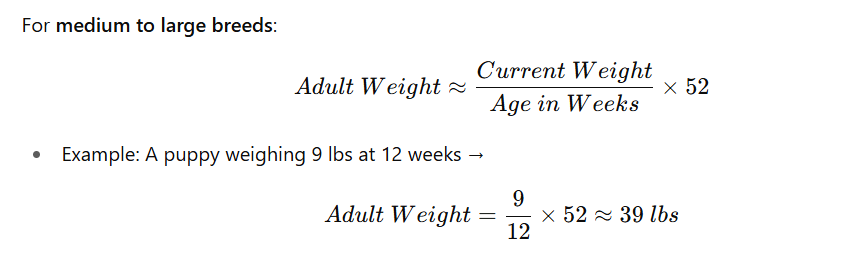
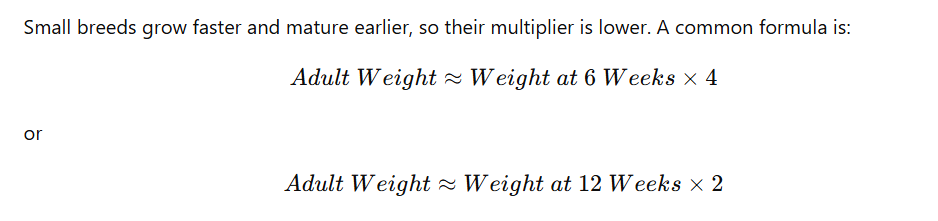
Toy & Small Breed Adjustment
Age-Based Multipliers (General Guide)
Puppy Age | Growth Multiplier | Notes |
8 weeks | x4 | Early growth, small breeds mature quickly |
12 weeks | x3 | Reliable for most breeds |
16 weeks | x2.5 | Medium to large breeds stabilize |
6 months | x2 | Large breeds still growing significantly |
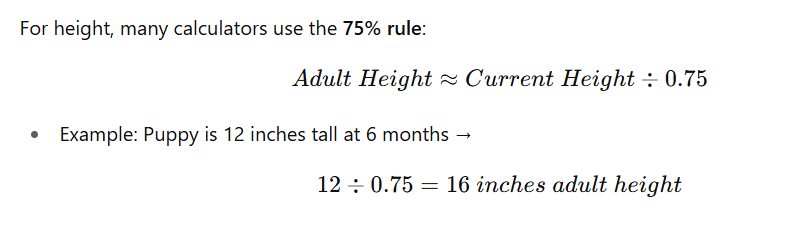
Height Prediction Formula
Gender Adjustment
- Males are typically 10–20% larger than females of the same breed.
- Our calculator applies a gender multiplier to refine estimates.
Why a Range Instead of One Number?
Since nutrition, genetics, and exercise affect growth, calculators provide a range (e.g., 55–75 lbs) rather than a single number to reflect natural variation.
Core Growth Formula We Use
The calculator applies formulas that breeders and veterinarians often use to project growth. For medium and large breeds, the four-month doubling rule is common: a puppy’s weight at 16 weeks is roughly half of its adult weight. Toy breeds, however, grow faster, so the six-week multiplier (weight × 4) works better for them. For giant breeds, slower growth means using extended multipliers across several months. By blending these formulas with breed averages, the calculator avoids relying on only one method. This ensures the estimate adapts to different size categories and growth speeds, giving owners a realistic outlook.
Age-based Multipliers & Breed Adjustments
Growth is not uniform across breeds. Small dogs reach maturity earlier, while giant breeds take nearly two years to complete their growth. That’s why the calculator doesn’t just apply one universal formula. Instead, it uses age-based multipliers that align with breed-specific data. For example, at 6 months, a Beagle may already be near full size, while a Great Dane is only halfway there. This adjustment ensures that the predictions reflect the actual biology of the dog rather than a one-size-fits-all estimate. By tailoring calculations, the tool accounts for the wide variety in canine growth.
Gender Adjustments & Growth Ceilings
Gender also plays a major role in determining size. In most breeds, males are 5–15% larger than females in both weight and height. Ignoring this difference could lead to underestimation or overestimation of size. The calculator applies a gender adjustment to make sure that the predictions reflect realistic growth ceilings. For instance, a male Labrador may fall closer to 75–80 lbs, while a female from the same line may settle closer to 60–70 lbs. Factoring in gender prevents owners from misjudging product sizing and helps with better preparation as their pup matures.
Data Sources & References (e.g. growth studies, veterinary charts)
The strength of the calculator lies in its foundation of scientific references and veterinary charts. Breed weight ranges, growth timelines, and gender differences are sourced from kennel club data, veterinary textbooks, and published canine growth studies. These references are combined with real-world owner-reported data to make the tool more applicable across different dogs. By drawing from verified veterinary knowledge, the calculator produces trustworthy results that reflect how dogs actually grow in practice, not just in theory. This makes it a reliable guide for dog parents planning their pet’s future size.
How to Measure Dog Height & Length Accurately
Accurate measurements are essential for predicting growth and buying correctly sized products like harnesses, jackets, or beds. Many owners measure incorrectly by including the head or measuring a sitting dog. To get proper results, measurements should always be taken while the dog is standing naturally on all fours. This way, predictions and product sizing both become more precise. Following a step-by-step process reduces mistakes and gives you results you can depend on.
Step-by-Step Guide (with illustrations)
- Place your dog on a flat, even surface.
- Make sure the dog is standing naturally — not sitting or stretching.
- Use a soft measuring tape or yardstick for accuracy.
- Record measurements in either inches or centimeters consistently.
- Compare your results with breed standards or input them into the calculator.
Measuring Shoulder Height (Withers)
The withers are the highest point of the shoulders, located where the neck meets the back. To measure:
- Hold the tape measure vertically from the ground up to the withers.
- Keep the tape straight and ensure the dog is standing still.
- Record the height in inches or centimeters.
Measuring Body Length / Back Length
To measure body length:
- Start at the base of the neck where the collar sits.
- Run the tape along the spine to the base of the tail.
- Avoid measuring to the tip of the tail, as this overestimates length.
Common Mistakes & How to Avoid Them
- Measuring while sitting or lying down: Always measure when the dog is standing.
- Including the head: Height is measured to the withers, not the head.
- Loose tape placement: The tape should be firm and straight, not curved.
- Mixing units: Stick to either inches/cm or lbs/kg to avoid errors.
Avoiding these mistakes ensures that the calculator produces reliable predictions and that products from collections like dog harnesses or dog hoodies fit correctly.
Dog Size Classification & Charts
Dogs are generally grouped into categories that make it easier to compare growth patterns and shop for suitable products. These categories are Toy, Small, Medium, Large, and Giant. Each has defined weight and height ranges based on breed averages. This classification helps owners understand where their dog falls now and what to expect in the future.
Category-Wise Dog Size Table (Toy / Small / Medium / Large / Giant)
Category | Weight Range | Height Range | Example Breeds |
Toy | Up to 12 lbs | Under 10 in | Chihuahua, Yorkie |
Small | 13–25 lbs | 10–16 in | French Bulldog, Pug |
Medium | 26–50 lbs | 17–22 in | Beagle, Cocker Spaniel |
Large | 51–100 lbs | 22–27 in | Labrador, Golden Retriever |
Giant | 100+ lbs | 28+ in | Great Dane, Saint Bernard |
Product-Size Mapping: Which of Our Collections Fit Each Category
At Supreme Dog Garage, we design collections with these categories in mind:
- Toy & Small breeds → Perfect for our Small Dog Clothes Collection and Lightweight Harnesses.
- Medium breeds → Fit comfortably into Medium Dog Hoodies, Collars & Leashes.
- Large breeds → Best suited for Large Harnesses, Outdoor dog Jackets.
- Giant breeds → Need Heavy-duty Dog Accessories, XL Coats.
By mapping categories to collections, owners can shop confidently without worrying about returns or poor fit.
What Influences Final Dog Size?
Even with formulas, external factors shape how big a dog becomes. Growth isn’t determined only by breed, nutrition, health, and environment also matter. Understanding these influences helps explain why two dogs from the same breed can grow very differently.
Age & Growth Stage
Puppies grow the fastest in their first 6 months. After this, growth slows but continues until full maturity. Age gives the strongest clue about where the dog is on their growth curve, and predictions adapt accordingly.
Gender / Sex Differences
Males generally grow larger than females of the same breed. Factoring in gender narrows the prediction range, making estimates more accurate.
Genetics & Parental Size
The size of the parents often indicates the puppy’s potential size. Larger parents usually produce larger offspring.
Nutrition, Health & Exercise
A balanced diet ensures steady growth, while poor nutrition can stunt development. Overfeeding can also cause obesity, which is not the same as healthy growth. Exercise supports bone and muscle strength.
Neutering / Spaying Effects
Early neutering can delay growth plate closure, sometimes resulting in slightly taller but leaner dogs. Spaying or neutering later usually keeps growth within standard ranges.
Short Case Example: How Different Factors Shift the Estimate
A male Golden Retriever with large parents, high-quality nutrition, and late neutering may reach 80 lbs, while a female from smaller parents with restricted nutrition may only reach 55 lbs.
Dog Size Through Life Stages
Dogs grow and change through different phases of life. Knowing these stages helps owners manage nutrition, exercise, and product choices.
Puppy Stage (8 Weeks – 6 Months)
Rapid weight and height gain. Puppies often double in size during this stage.
Older Puppy / Adolescence (6 – 12 Months)
Growth slows but continues. Muscles and bones strengthen, and behavior matures.
Young Adult (1 – 3 Years)
Most breeds are fully grown. Large breeds may still gain muscle mass.
Adult / Mature (3 – 7 Years)
Dogs maintain size, but metabolism may slow down, requiring diet adjustments.
Senior / Aging Dogs: Growth Plateau & Change
Older dogs don’t grow, but their weight may fluctuate due to reduced activity or health conditions.
How Size Varies from Toy to Giant Breeds
Toy Breed Trends & Growth Ceilings
Toy breeds grow quickly and reach adult size within a year. Their compact size makes them easy to carry and dress in small dog clothes.
Small vs Medium Breed Differences
Small breeds are slightly heavier than toy breeds but mature around the same age. Medium breeds take longer and often need sturdier gear like medium harnesses.
Large & Giant Breed Extended Growth
Large and giant breeds can take up to two years to fully grow. They need strong gear such as large harnesses and XL jackets to support their size.
Extreme Cases & Exceptions
Designer mixes and unusual genetics may push dogs above or below average ranges, making them exceptions in growth charts.
Expert Insights & Best Practices
Advice from Vets & Canine Nutritionists
Track growth regularly, feed balanced meals, and adjust portions as your dog ages.
Monitoring Growth Safely (Schedules, Checkups)
Routine vet visits ensure your puppy stays on a healthy path.
Adjusting Feeding & Exercise Through Growth
Provide moderate exercise and portion-controlled meals to support a healthy size.
When to Consult a Professional
If growth is much faster or slower than predicted, consult your vet for guidance.
Summary: Why This Dog Size Calculator Stands Out
Our Dog Size Calculator combines veterinary research, breed-specific charts, and proven formulas to create more accurate predictions. It takes into account age, weight, gender, and breed to give ranges that reflect your dog’s growth. While no calculator can provide guarantees, this tool is a practical guide for planning your dog’s future. Entering accurate inputs ensures the best results, and pairing predictions with proper nutrition, exercise, and veterinary advice gives your pup the healthiest start.